
Formulation of Spring Element
Basically you know what is a spring. To model a spring in FEM it is best to use one dimensional spring element with 2 nodes as shown below. The element type is therefore is Linear Spring.

1 and 2 are the node numbers
U1 is translation in x direction at node 1.
U2 is translation in x direction at node 2.
f1 is the force action in x direction at node 1
f2 is the force action in x direction at node 2
K is the stiffness of the spring
Above items are the basic of FEM and the basic items in a idealized spring element. It is assumed that spring obeys hooke’s law and resists forces only in the direction of the spring.
A linear displacement function can be assumed for this element as shown below.
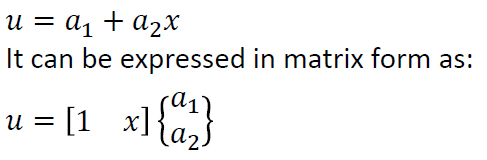
We can input the nodal values to determine the coefficients.
u(0) = u1 = a1
u(L) = u2 = a2L + u1
a2 = (u2 – u1 )/L
Therefore the linear displacement function can be expressed as below in nodal terms

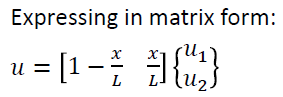
Alternatively, When N1 = 1-x/L , N2 = x/L ( N1,N2 are called shape functions)

Above matrix is the typical format of the displacement function.
Sum of all shape functions should be equal to 1 .

Above figure shows how shape function value varies with the x distance.
Now lets consider the strain-displacement relationship,by assuming constant strain throughout the element
Stiffness of a spring element is calculated by K =AE/L
A= cross section area, E= Young’s Modulus , L = Length of the Element

For the spring element,

Where T is the force in the spring taken as positive for tensile.
Consider the forces in the spring to be positive if tensile and its value being T

This is the system of equations that represent a spring element
The Local Element Stiffness Matrix of Spring is As Below

Above formulation is used to analyse spring elements of a structure. Example problem for springs will be solved in the next post and you will be able to understand how to interpret the spring element in a real situation.
 Supun AJ Engineering Blog
[…] we all know a spring element only has two Degrees of Freedoms. Check the formulation of Spring Element for more […]
LikeLike